Showing posts with label memorials. Show all posts

Monday, 17 September 2018

The memorial to Sir Arthur Sullivan, Embankment Gardens, London


Sir Arthur Sullivan (1842-1900) was the composer half of “Gilbert and Sullivan” who wrote a series of comic operas in the late 19th century that have been performed to great acclaim ever since. Sullivan was also a composer of note in other fields, particularly choral church music. His best-known contribution in this genre was probably the hymn tune to “Onward Christian Soldiers”. 

The Gilbert and Sullivan operas were staged at the Savoy Theatre in London’s Strand, so it is appropriate that the memorial to Sir Arthur stands in the Embankment Gardens facing in the direction of the Savoy Hotel and Theatre, although his bronze bust, if granted the gift of sight, would find that his view was obscured by high buildings. 

The memorial is conventional enough in concept, in that it is a bust on a stone plinth, but there are features that make it somewhat unusual. 

At the base of the plinth, to one side, is an extra piece of bronze consisting of a mandolin, a mask of Pan, and a score of one of Gilbert and Sullivan’s works, namely The Yeoman of the Guard. 

However, what catches the eye to a far greater extent is the figure of a young woman clasping the plinth in a pose that conveys great distress. Even more remarkable is the fact that her emotional state has caused her costume to fall to her waist, leaving her upper portion naked. 

One has to ask – why? The figure of the girl was not originally modelled with the Sullivan memorial in mind, having been made in Paris in 1899 when Sir Arthur was still alive, but somebody clearly thought that it would convey the sorrow that many people felt at the loss of the great man. Whether they would be adequately represented by a half-naked young woman is a matter for conjecture. 

It might have been thought that the figure was reminiscent of one of the Gilbert and Sullivan operas, namely Patience, which features “rapturous maidens” draping themselves over the object of their affection, the poet Reginald Bunthorne who was loosely modelled on Oscar Wilde. If that is so, potential opera-goers need to be reassured that – in the vast majority of performances – all such maidens stay fully dressed throughout the show! 

At all events, the afterthought of adding the maiden to the plinth has resulted in what is probably one of the more erotic memorials to be found in London!

© John Welford

Monday, 19 March 2018

Hyde Park Corner: Memorials to the Duke of Wellington


The area around London’s Hyde Park Corner is of great interest to anyone who admires the memory of one of Britain’s greatest ever generals, namely Arthur Wellesley, the 1st Duke of Wellington (1769-1852), who was the hero of the Battle of Waterloo.

For one thing, this is where you will find the Duke’s London home, Apsley House, which once had the iconic address “No 1, London” because it was the first house inside the turnpike gate at Hyde Park Corner, which is traditionally the point from which all distances to London from everywhere else in the country are measured.

Apsley House, now under the care of English Heritage, is open to visitors and contains many paintings and other items that were formerly owned by the Duke of Wellington.

Opposite the front of Apsley House is a small green area, surrounded by a busy traffic circulatory system, on which are several memorials and monuments of military significance.

Wellington Arch

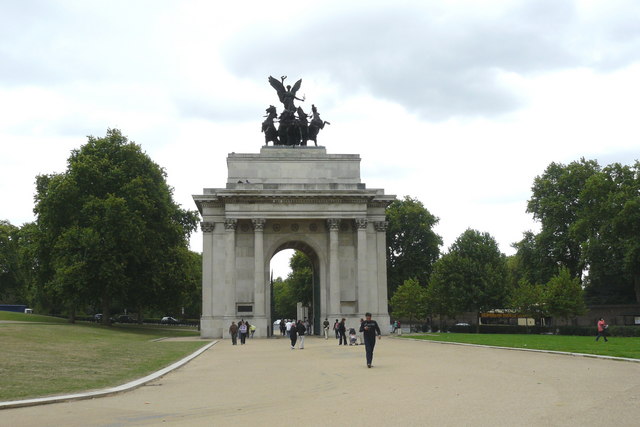
The most notable of these is the massive Wellington Arch – not to be confused with Marble Arch which is at the northeast corner of Hyde Park as opposed to the southeast. It was built in 1826-30 to a design by Decimus Burton and was originally sited as the western entrance to Constitution Hill, which runs from Hyde Park to one side of Buckingham Palace. However, it was moved a short distance to its present position in 1882-3, although it is still in alignment with the course of Constitution Hill. The Arch is also known as Constitution Arch.

The Arch originally had a large equestrian statue of Wellington on top, but this was moved to Aldershot early in 1887 to eventually be replaced by a statue by Adrian Jones entitled “Peace in her Quadriga”, which was cast in 1912 and remains Europe’s largest bronze statue.

The Arch contains rooms on either side and across the top, and these are open to the public, who can view an exhibition about London’s statues. From the 1950s until 1992 these rooms comprised London’s smallest police station, providing a base for two sergeants, 10 constables and a cat!

Wellington Memorial

Directly opposite Apsley House, and therefore at an angle to Wellington Arch, is the monument that took the place of the one that was removed from the top of the Arch. This is a bronze, by J E Boehm, of Wellington astride Copenhagen, his favourite warhorse. It was erected in 1888.

Copenhagen was certainly a remarkable horse, having been Wellington’s mount at the Battle of Waterloo for more than 16 hours all told. The story goes that, after the battle, Wellington dismounted in the stable block and Copenhagen, relieved to be off duty at last, lashed out with such fury in his master’s direction that, had he connected, Wellington would have joined Nelson as a great military victor cut down in the hour of his triumph.

The Memorial statue stands on a stone plinth that is “guarded” by the figures of four soldiers who are representatives of troops at the Battle of Waterloo. These are a Grenadier, a Welch Fusilier, an Inniskilling Dragoon and a Royal Highlander. These figures were cast from 12 French cannons that were captured during Wallington’s campaigns.

The Statue of Achilles

On the other side of Apsley House, just inside Hyde Park, is a somewhat curious memorial to the Duke of Wellington, namely a huge bronze figure that purports to be Achilles.

This was the “Ladies’ Trophy”, so called because it was paid for by subscriptions from the women of Britain as their tribute to the Duke. It was modelled by Sir Richard Westmacott and erected in 1822.

One problem with the statue is that it has nothing to do with either the Duke of Wellington or Achilles. It is actually a copy of a statue of a horse-tamer, with sword and shield, in Rome. However, the main reason why it raised plenty of eyebrows in 1822 is that the warrior depicted is almost entirely naked without even the benefit of a fig-leaf! The question has often been raised about how much the ladies who commissioned the statue knew about what they were going to get!

© John Welford

Sunday, 8 May 2016

The Memorial to Heroic Self Sacrifice, Postman's Park, London


The Memorial to Heroic Self Sacrifice was the brainchild of George Frederic Watts, a Victorian painter and philanthropist who thought that public recognition should be made of ordinary London people who had died while trying to save others. The Memorial can still be seen in London today.


George Frederic Watts

George Frederic Watts (1817-1904) was a very popular artist during his lifetime (a painter and sculptor) but he is not as highly regarded today. His works, many of which were portraits, were symbolic and allegorical and intended to give uplifting messages to their viewers.

He has been described as a philosophical artist and a “preacher in paint”, but the preaching, while striking a chord among his fellow Victorians, is less welcome in modern times. In his own words, he sought to “condemn in the most trenchant manner prevalent vices” and give “warning in deep tones against lapses from morals and duties”.

Perhaps it was ironic that his first wife, the actress Ellen Terry who was 16 years old at the time (he was 30 years older), did not share his high moral aspirations and eloped with another man only a year after the wedding!

A great admirer of royalty, Watts proposed his Memorial to Heroic Self Sacrifice as a contribution to the celebrations to mark the golden jubilee of Queen Victoria in 1887, but the idea was turned down at the time. It was not until 1898 that he was able to turn his idea into reality.


The Memorial to Heroic Self Sacrifice

The plan was to commemorate the selfless actions of ordinary people who had died while trying to save others. This would be done be placing ceramic plaques, giving details of their deeds, on a public wall where people could read what they had done.

A wooden loggia was designed by Ernest George, an architect and painter. The loggia provided shelter for anyone reading the plaques, for which space was made available for 120 of them.


Postman’s Park

The Memorial was placed in Postman’s Park, an open space in the City of London not far from St Paul’s Cathedral. This area was opened as a park in 1880, being the site of adjoining former churchyards. It takes its name from the fact that it was next door to the former General Post Office and workers from there used it during breaks from work.


Collecting the stories and mounting the plaques

George Frederic Watts was only able to start the project late in life, being in his 80s when the first plaques were made and mounted in the loggia. Indeed, at the time it was opened in 1900 there were only four plaques in place. By the time of his death in 1904 (at the age of 87) only another nine had been added.

Watts’s widow Mary (his second wife who was, like his first, more than 30 years his junior) then took on the role of commissioning the plaques.

Watts had spent many years collecting stories of self-sacrifice, and Mary’s task was therefore to work down his list and raise the funds to get the plaques made. These were initially made by William de Morgan, a well-known ceramicist. She also commissioned a memorial to her husband to be set alongside the plaques.

Unfortunately, De Morgan stopped making ceramics in 1907 and Mary Watts was forced to go to another supplier, namely Royal Doulton. These were not of the same quality or colour as the originals. Eventually, Mary Watts decided that she could not continue the project as she wanted to concentrate on building a chapel and gallery devoted to the memory of her late husband.

The Memorial is therefore unfinished to this day. Instead of 120 plaques there are only 54. Of these, three were added during World War I, one in 1927 and the final one in 2007. The original design allowed for five rows of plaques, but the top and bottom rows remain empty.


 Some examples of the plaques

The stories told on the plaques clearly cannot be complete, and they are therefore frustrating in what they are forced to leave out. Even so, they say enough to make it clear that the people in question deserve to be commemorated.

Here are some examples:

William Donald of Bayswater. Aged 19. Railway clerk. Was drowned in the Lea when trying to save a lad from a dangerous entanglement of weed. July 16 1876

Mary Rogers. Stewardess of the Stella. Mar 30 1899. Self sacrificed by giving up her life belt and voluntarily going down in the sinking ship.

Henry James Bristow. Aged eight – at Walthamstow. On December 30, 1890 – saved his little sister's life by tearing off her flaming clothes but caught fire himself and died of burns and shock.

Daniel Pemberton. Aged 61. Foreman LSWR. Surprised by a train when gauging the line hurled his mate out of the track saving his life at the cost of his own. Jan 17 1903.

And the most recent plaque:

Leigh Pitt. Reprographic operator. Aged 30, saved a drowning boy from the canal at Thamesmead, but sadly was unable to save himself. June 7, 2007.

It has to be said that there is more than a little Victorian mawkishness and sentimentality about this Memorial, but even so it does commemorate real people who died while saving others, and their stories would almost certainly have been forgotten were it not for the efforts of George Frederic and Mary Watts.


© John Welford

Monday, 21 March 2016

The Blitz Memorial, St Paul's Churchyard, London


This memorial is to the 1002 fire-fighters who lost their lives during the London Blitz which lasted from September 1940 to May 1941. In all there were 71 attacks on London, 57 of them being on consecutive nights. More than a million homes were damaged to a greater or lesser extent and 20,000 people were killed.

The toll of death and destruction would no doubt have been considerably greater were it not for the efforts of the London Fire Brigade, and it is therefore fitting that the sacrifice of so many of their members is recognised in this way. The bronze, by John W Mills, shows three fire-fighters in action, two of them pointing a hose and the third directing operations. The statue was unveiled by Queen Elizabeth the Queen Mother on 4th May 1991.

The location of the monument is entirely appropriate. It is in Old Change Court, which is on the south side of St Paul’s Cathedral (on the other side of St Paul’s Churchyard). One of the iconic images of World War II is of the dome of St Paul’s rising out of the smoke of burning buildings on all sides. Although St Paul’s did not receive a direct hit from a high explosive bomb, many incendiary devices landed on its roof and were dealt with by firemen and cathedral staff, despite the difficulty of getting water up to that level (sandbags and water pumps were used to good effect).

Winston Churchill had decreed that St Paul’s must not be allowed to burn, given the boost to morale that saving the Cathedral would provide. The fact that the second St Paul’s survived the second “Great Fire of London”, whereas the original building perished along with much of London in 1666, is down to the heroics of the men commemorated by the memorial in Old Change Court.


© John Welford

Wednesday, 10 February 2016

The Albert Memorial, Hyde Park, London


The monument to Prince Albert in Kensington Gardens, London, is one of the finest and most elaborate to be found anywhere in the country, let alone London. It is a splendid piece of Victoriana that is as much a memorial to the spirit of that age as it is of the Prince himself. It complements the nearby Royal Albert Hall, built at around the same time, towards which the statue of Prince Albert faces.

Prince Albert of Saxe-Coburg and Gotha was the husband of Queen Victoria. They married in 1840 but Albert died of typhoid in 1861 at the age of only 42. Perhaps unusually for an arranged royal marriage, the couple were very much in love with each other from the start and Victoria felt his loss very deeply indeed. When the time came to propose a permanent memorial to him, it was clear that no expense would be spared, with the actual cost of £120,000 being met by public subscription.

Likewise, the recent restoration of the Albert Memorial to its original state, after more than a century of exposure to the elements, has been an expensive business. More than eleven million pounds were spent on an 8-year project that ended with the Memorial’s unveiling in 1998.

At the heart of the memorial is a seated statue of Prince Albert, three times life size. He is dressed as a Knight of the Garter and he holds a catalogue of the 1851 Great Exhibition of which he was a prime instigator and organiser. The whole memorial reflects the ethos of that Exhibition (which took place in Hyde Park, very close to the site of the Memorial) and illustrates Albert’s wide-ranging interests.

The statue was the work of John Foley, who was commissioned personally by Queen Victoria. Although the Memorial was, as mentioned above, funded by public subscription, Victoria paid for the actual statue herself. A model of the statue was first placed on its plinth in 1870, but the full gilt-bronze version only appeared in 1875, three years after the Memorial was opened. It was painted black at some time before the First World War, probably to mask the pitting of the gold by atmospheric pollution, but the recent restoration included a full coating of gold leaf.

However, the Memorial is far more than the statue of Prince Albert. It was designed by Sir George Gilbert Scott and takes the form of a “ciborium” or canopy that acts as a roof to the statue – a very upmarket gazebo, one might say. Scott was a leading exponent of the Gothic Revival – he designed St Pancras Station for example – and it is no surprise that the Memorial has many Gothic features, including church-like composite pillars, pointed arches and an emphasis on height – the cross at the top is 176 feet above ground level.

One can spend a long time taking in everything that the Memorial has to offer. For example, below the plinth on which the statue rests is a frieze, on all four sides, that depicts 169 practitioners in the arts. The south side features musicians and poets, on the east side are painters, to the north are architects and on the west side are sculptors.

On the corners of the canopy base are sculptural groups representing Agriculture, Commerce, Engineering and Manufacture, and further out, on the corners of the wider platform, are groups to represent the continents of Asia, Africa, America and Europe – which is a bit tough on Australia!

Further up the canopy are mosaics that feature Poetry, Painting, Architecture and Sculpture, and there are statues to represent the practical arts and sciences, and the cardinal and theological virtues.

The friezes and sculptures were created by a number of different artists.

Around the canopy are inscribed the words: “Queen Victoria And Her People To The Memory Of Albert Prince Consort As A Tribute Of Their Gratitude For A Life Devoted to the Public Good”.

All in all, one can spend a considerable time looking at everything that the Albert Memorial has to offer – it is a veritable museum of sculpture all on its own. However, in order to do so one should take a pair of binoculars, not only to see the features high up on the structure but because there is no public access closer than the outermost “continent” sculptures. Highly ornate railings keep people at bay, which is understandable given that some of them might be tempted to scrape the gold off Albert’s statue!


© John Welford