Monday, 19 March 2018

In the footsteps of Queen Elizabeth I at Worcester


Arthur, Prince of Wales, was the elder brother of Henry, who became King Henry VIII. Arthur was born in September 1486, just over a year after his father, Henry Tudor, had become King Henry VII by virtue of his victory over King Richard III at the Battle of Bosworth.

Arthur was therefore seen as the great hope for a new Tudor dynasty, and a suitably prestigious marriage was arranged for the future king. This was to Catherine, the daughter of Isabella of Castile and Ferdinand of Aragon. The betrothal took place when Arthur and Catherine, who was a few months older than Arthur, were still young children, and the marriage took place by proxy in 1499, when they were still too young to be husband and wife in anything but name.

The couple met for the first time in November 1501, shortly before their official marriage in St Paul’s Cathedral. They were sent to Ludlow Castle, on the border between England and Wales, to begin their life as Prince and Princess of Wales, but disaster was to strike only a few months later.

A mystery illness – probably a viral infection – swept across the region early in 1502. Both Arthur and Catherine fell victim to it and were confined to bed in the hope of recovery. Catherine did indeed recover, but Arthur did not.

This event was to have massive repercussions in later years, because Catherine was then passed on to Henry’s new heir, then aged 11. They married seven years later, and it was her failure to produce a male heir that led to the drama of the English Reformation.

Arthur’s death, at the age of 15, was clearly a great tragedy that called for a suitable resting place to be found for his remains. This was Worcester Cathedral, not far from Ludlow, and already a royal resting place due to the tomb of King John that had been there since 1216.

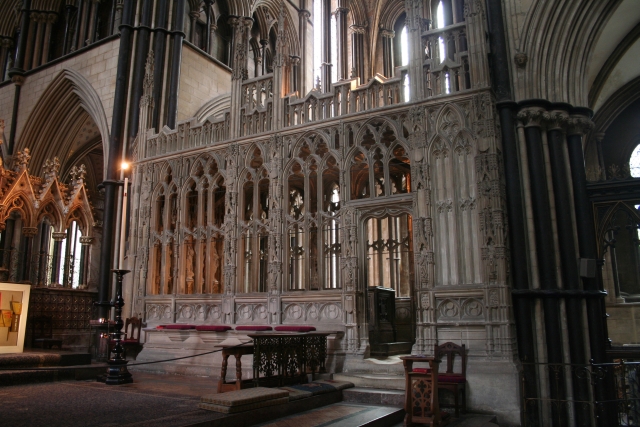
Arthur’s tomb was placed not far from that of King John, but in a separate chantry chapel to one side of the altar steps. The tomb, which is not topped by an effigy of Prince Arthur, occupies most of the space, but it is possible to walk all round the tomb to pay one’s respects. The stonework of the chapel was intricately carved, but some of the figures of saints still bear the marks of the axes of Cromwell’s soldiers who did their best to eliminate such signs of Catholic idolatry in the 17th century.

Entry to the chapel is via two stone steps, which have been worn down by the feet of many thousands of visitors during the 500 and more years since they were put in place. It is known that one such visitor was Queen Elizabeth I who came to Worcester to pay homage to her royal predecessor King John and her late uncle Prince Arthur, who had died more than 30 years before she was born.

Today’s visitors can therefore know that their feet are treading exactly where those of Queen Elizabeth trod nearly 500 years previously. To be accurate, though, today’s footprints are probably a couple of inches lower than those of Good Queen Bess!
© John Welford

Ice houses: how the landed gentry kept things cool


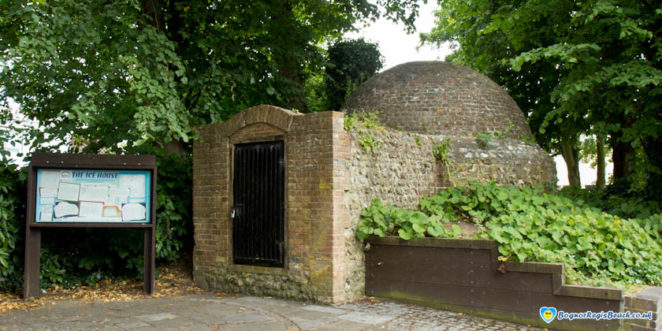
Before the invention of electric refrigerators, how did you keep your food fresh and prevent it from becoming uneatable? If you were rich and lived in a large country house, you would probably build an ice house. Many of these were constructed between the 17th and 19th centuries and surviving ice houses can be seen in the grounds of preserved stately homes in England and elsewhere.

The idea was that ice would be collected from frozen lakes in winter and stored in a cellar that was designed with the sole purpose of preventing the ice from melting for as long as possible. The ice could then be used throughout the year – both to provide a cool storage space for perishable food and as an ingredient in dishes such as ice creams and sorbets that would be very welcome on a hot summer’s day.

Most large country estates had a lake – which was both an attractive feature of the landscaped grounds and a source of fish for the kitchen. Parts of the lake would be shallower than others and be shaded from direct sunlight – these would therefore be more likely to freeze solid so that ice could be carved out in large blocks.

A typical ice house would be built in the grounds at a distance from the main house. This would ensure that no heat from the house would transfer to the ice. A typical design involved a pit being dug – often as deep as 20 to 30 feet – and lined with brick. In some cases a drainage channel was provided at the bottom of the pit to allow meltwater to drain away – this might well return the water to the lake from which the ice had been taken.

Temperatures at this sort of depth would be naturally cool because no heat could percolate to that depth. Extra measures were taken to ensure this, such as by building an earth mound on top of the domed roof of the pit and surrounding it with a grove of trees that would keep direct sunlight at bay.

The entrance to the ice house had to be wide enough to allow the ice blocks to be taken through and the produce to be carried in and out. However, there was a risk that the entrance could also allow heat to reach the ice, so it was placed on the north side of the ice house and often took the form of a low brick-lined tunnel through which sunlight could never penetrate.

Another precaution was to pack the ice in straw, which acted as insulation.

The evidence shows that ice houses worked extremely well, even to the extent that a mild winter in which little ice became available did not mean that the ice house became redundant. This was because it could take as long as 18 months for all the ice to melt.

The idea of packing food in ice probably goes back to medieval times or even earlier, but the first known example of a “modern” ice house dates from 1619, this being the one at Greenwich Park in what is now south London. This was built on the orders of King James I, who – having spent his early life in Scotland – was used to having plenty of ice around well into the Spring months. King James later had an ice house built at Hampton Court.

Not surprisingly, many aristocrats and landed gentry followed the royal example. Although many of these ice houses have been lost over the years due to collapse and redevelopment, there are also some notable surviving examples. One of these is at Hanbury Hall in Worcestershire, and another is at Hotham Hall in Bognor Regis, West Sussex.
© John Welford

Hyde Park Corner: Memorials to the Duke of Wellington


The area around London’s Hyde Park Corner is of great interest to anyone who admires the memory of one of Britain’s greatest ever generals, namely Arthur Wellesley, the 1st Duke of Wellington (1769-1852), who was the hero of the Battle of Waterloo.

For one thing, this is where you will find the Duke’s London home, Apsley House, which once had the iconic address “No 1, London” because it was the first house inside the turnpike gate at Hyde Park Corner, which is traditionally the point from which all distances to London from everywhere else in the country are measured.

Apsley House, now under the care of English Heritage, is open to visitors and contains many paintings and other items that were formerly owned by the Duke of Wellington.

Opposite the front of Apsley House is a small green area, surrounded by a busy traffic circulatory system, on which are several memorials and monuments of military significance.

Wellington Arch

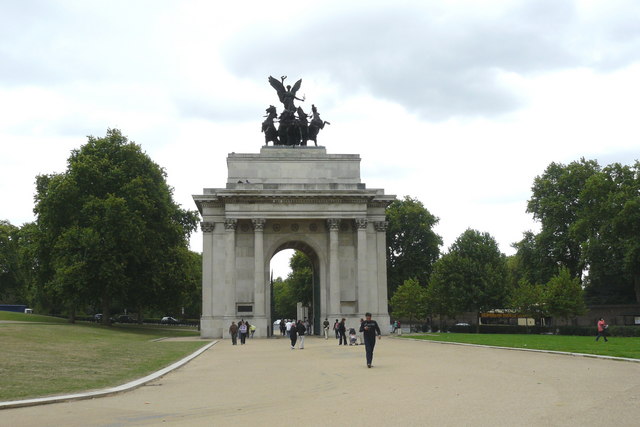
The most notable of these is the massive Wellington Arch – not to be confused with Marble Arch which is at the northeast corner of Hyde Park as opposed to the southeast. It was built in 1826-30 to a design by Decimus Burton and was originally sited as the western entrance to Constitution Hill, which runs from Hyde Park to one side of Buckingham Palace. However, it was moved a short distance to its present position in 1882-3, although it is still in alignment with the course of Constitution Hill. The Arch is also known as Constitution Arch.

The Arch originally had a large equestrian statue of Wellington on top, but this was moved to Aldershot early in 1887 to eventually be replaced by a statue by Adrian Jones entitled “Peace in her Quadriga”, which was cast in 1912 and remains Europe’s largest bronze statue.

The Arch contains rooms on either side and across the top, and these are open to the public, who can view an exhibition about London’s statues. From the 1950s until 1992 these rooms comprised London’s smallest police station, providing a base for two sergeants, 10 constables and a cat!

Wellington Memorial

Directly opposite Apsley House, and therefore at an angle to Wellington Arch, is the monument that took the place of the one that was removed from the top of the Arch. This is a bronze, by J E Boehm, of Wellington astride Copenhagen, his favourite warhorse. It was erected in 1888.

Copenhagen was certainly a remarkable horse, having been Wellington’s mount at the Battle of Waterloo for more than 16 hours all told. The story goes that, after the battle, Wellington dismounted in the stable block and Copenhagen, relieved to be off duty at last, lashed out with such fury in his master’s direction that, had he connected, Wellington would have joined Nelson as a great military victor cut down in the hour of his triumph.

The Memorial statue stands on a stone plinth that is “guarded” by the figures of four soldiers who are representatives of troops at the Battle of Waterloo. These are a Grenadier, a Welch Fusilier, an Inniskilling Dragoon and a Royal Highlander. These figures were cast from 12 French cannons that were captured during Wallington’s campaigns.

The Statue of Achilles

On the other side of Apsley House, just inside Hyde Park, is a somewhat curious memorial to the Duke of Wellington, namely a huge bronze figure that purports to be Achilles.

This was the “Ladies’ Trophy”, so called because it was paid for by subscriptions from the women of Britain as their tribute to the Duke. It was modelled by Sir Richard Westmacott and erected in 1822.

One problem with the statue is that it has nothing to do with either the Duke of Wellington or Achilles. It is actually a copy of a statue of a horse-tamer, with sword and shield, in Rome. However, the main reason why it raised plenty of eyebrows in 1822 is that the warrior depicted is almost entirely naked without even the benefit of a fig-leaf! The question has often been raised about how much the ladies who commissioned the statue knew about what they were going to get!

© John Welford

Sunday, 18 March 2018

Holkham Hall, Norfolk


Holkham Hall is an enormous “stately home” in north Norfolk, an eastern county of England. It is not far from another splendid country house, namely Houghton Hall, and they both date from the same time, namely the 1720s (although they took more than a decade to complete).

Houghton Hall was the country seat of the man dubbed Britain’s first Prime Minister, namely Sir Robert Walpole. It therefore had a political message to drive home by emphasizing the power and prestige of its owner. Holkham Hall, on the other hand, says much more about the artistic refinement and cultivated taste of its creator, who was Thomas Coke, a wealthy landowner and Member of Parliament who would later be created Earl of Leicester.

As a young man, Thomas Coke underwent the “Grand Tour” of Europe that was typical for many sons of the gentry. However, Coke took six years to complete his tour, returning to England in 1718. He had spent much of his time in Italy where he acquired many pieces of art and objets d`art and also gained a love of the Palladian architectural style. He therefore determined that he would create his own Italianate palace on his home estate.

Thomas Coke designed the house himself, but took advice from his friend William Kent, who had also been involved in the planning of Houghton Hall. Kent was particularly influential in the interior design of Holkham Hall.

The Hall consists of a massive central block with a classical pediment and a pair of end towers, and there are four smaller corner pavilions. The building, which is nearly 350 feet long, was built in a local yellow brick that was as close as Coke could get to Roman Renaissance brickwork.

Although the building’s exterior is somewhat austere, the interior is very different. The entrance hall, which was modelled on a Roman temple, reaches to the full height of the building and contains an impressive colonnade made from Derbyshire alabaster. The saloon has a gilded ceiling and red Genoa velvet on the walls.

Thomas Coke’s collection of art and sculpture is impressively displayed in the staterooms and the Statue Gallery that contains the most complete collection of classical statuary in an English country house. The libraries contain books and paintings that collected on the Grand Tour.

Thomas Coke’s project proved to be not only lengthy in its completion but extremely expensive. He died in 1759, three years before the work was finished, and in debt to the tune of £90,000, which was an enormous sum at that time.

Holkham Hall, which stands in an estate of 3,000 acres, is owned privately but can be visited from Spring to Autumn on certain days of the week. The visitor will be well rewarded by what he or she sees.

© John Welford

Saturday, 17 March 2018

Green lanes in England and Wales


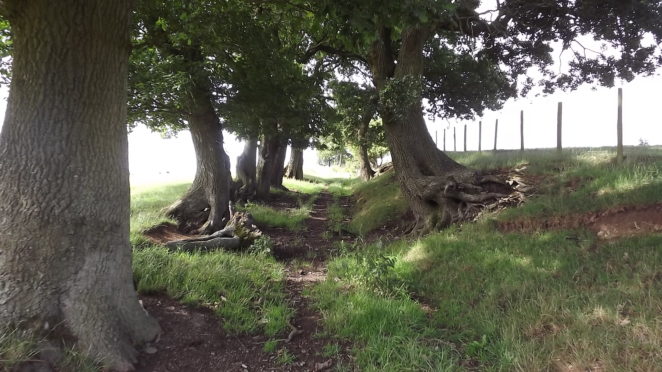
A green lane is an unsurfaced country road, of which some 5,000 miles exist in England and Wales. They are distinguished from footpaths by being wide enough for vehicles to use, but they are not recognised as official routes and are therefore not given road classifications.

The History of Green Lanes

Most green lanes have been in existence for many hundreds of years, and some of them for thousands. Some go back to Iron Age and Bronze Age times, being routes used by farmers to drive their animals to market or between upland and lowland pasture.

Many green lanes are routes between towns and villages that were abandoned when new roads were built. This happened, for example, when boggy land was drained and forests cleared, making it easier to travel along valleys and leaving the hilltop routes unwanted.

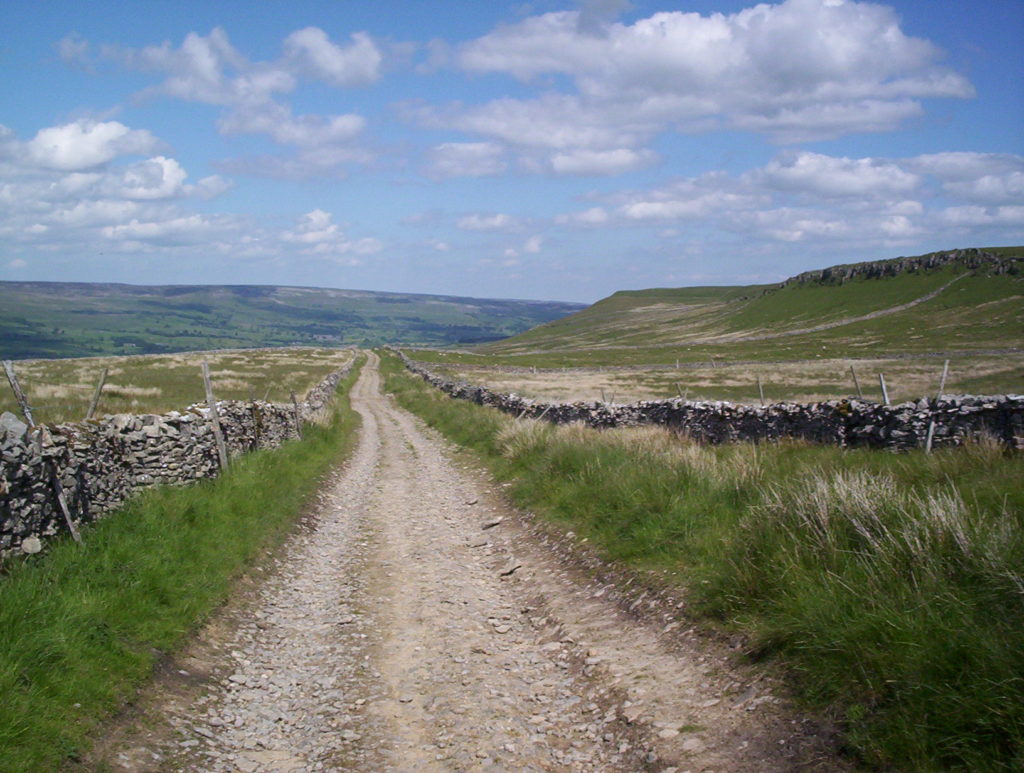
The Romans built Britain’s first long distance roads, which had the effect of leaving older routes to decay, and also providing more green lanes for the future. One such is in the picture below of a Roman road that climbs up a ridge between two Yorkshire dales.


In later centuries, many villages were abandoned for various reasons, included the enclosures of the 18th and 19th centuries. The tracks and roads that connected these villages therefore fell into disuse, as did many routes that now lead to dead ends due to the pattern of field boundaries having changed. Many of these roads now constitute today’s green lanes.

A more recent source of green lanes has been the closure programme of rural railway lines that arose from the “Beeching axe” of the 1960s. With the tracks removed the natural vegetation could return and new paths and tracks have been created as a result.

The Status of Green Lanes

The modern debate over green lanes concerns the rights of various groups to make use of them for recreational purposes. There have been several attempts to define, in law, the routes that may and may not be used by, for example, horse riders and drivers of motor vehicles. The latest of these is the Countryside and Rights of Way Act (2000), under which the following categories exist:

  • Public Bridleway. A route open to walkers and horse riders, but not motorised traffic. Cyclists are allowed to use bridleways, but may find cycling difficult in places.
  • Byways Open to All Traffic (BOAT). As the name suggests, anyone can use these, but they are unlikely to be suitable for all types of vehicle. Many drivers of large vehicles have found themselves in trouble when directed to use such a road by their satnav!
  • Restricted Byways (RP). These were formerly known as “Roads Used as Public Paths”, many of which had been reclassified (before the passage of the 2000 Act) as footpaths, bridleways or BOATs. The restriction is against motorised vehicles.
Controversy Over Use of Green Lanes

As might be expected, it is the use of green lanes by motor vehicles, particularly trail bikers and owners of 4x4s, that has led to controversy.

On the one hand, walkers and horse riders complain about the disturbance caused by bikers and off-roaders. There are concerns about ruts being dug into soft surfaces, thus turning green lanes into muddy brown ones. Wildlife disturbance is another issue.

Another problem occurs when people drive “old bangers” along green lanes and then abandon them when they break down or are driven into a ditch. Some people then decide that setting fire to an abandoned vehicle will ensure that it cannot be traced back to them, with the result that mangled wreckage then litters the countryside.

Conversely, trail bikers and off-roaders complain that not enough green lanes are designated as BOATs and too many are RPs. This has been a particular difficulty in the national parks, where the balance has been seen as going too far in the direction of non-motorised users.

Where Should the Line be Drawn?

As is often the case, it is irresponsible users of public facilities who give the rest a bad name. Responsible “greenlaners” (meaning bikers and 4x4 drivers) are fully aware that they are only allowed on BOATs and not RPs, and that their vehicles must be licensed and roadworthy, but there are many people who break the rules and thus encourage other people to advocate greater restrictions on their activities.

Of the 5,000 miles mentioned above as the extent of green lanes in England and Wales, about 3,000 miles were formerly classified as RUPPs, but many of these are now restricted (see above), so the balance has swung against the bikers and off-roaders and made it more likely that some will break the law, which is not easy to enforce given the remoteness of many of the areas in question.

What is needed is common sense by all parties, namely the various interest groups, local authorities and National Park authorities, so that the green lanes stay green, these precious resources are preserved for future generations, and the recreational needs of all types of user are taken into account.

© John Welford

Driving on the left: advice for visitors to the United Kingdom


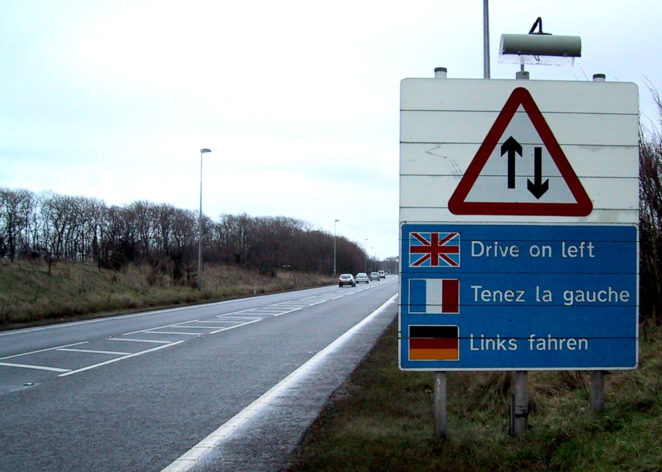
You have just arrived in the UK for your visit, picked up your hire car and ... got into the passenger side by mistake! This is one of a relatively small number of countries where the rule of the road is that you drive on the left, which also means that most cars have right-hand drive. That in itself presents a few challenges for those who are not used to it, but let’s concentrate here on the peculiarities of actually driving on the left.

When driving along a narrow road, whether in town or country, you will inevitably meet somebody coming the other way. Your natural tendency will be to swerve to the right to make room for the other vehicle. In Britain, this could cause a head-on crash, because the other driver will be swerving to his/her left, which is what you should have done. You must concentrate at all times and “think left”.

This is also essential when you need to turn into a multi-lane road that has a central refuge. Suppose that you have been on a minor road and have stopped when it meets a junction with a main road. To turn right, you must cross the traffic in two goes, stopping again before joining the flow of traffic going your way. Many nasty accidents have been caused when overseas drivers have forgotten where they are and turned right into the first carriageway they meet and not the second. You must also, of course, remember that at the first crossing the traffic is coming from your right and at the second it is coming from your left.

When you turn right from a main road into a side road you will be turning across the opposite side of your road, with traffic coming towards you from your left as you turn.  Whereas turning left was the tricky turn where you come from, here it is turning right. Also, be sure to turn into the left side of the road you are turning into, and not the right side.

Roundabouts are a particular feature of the British road system that you may not be used to. The rule is that you always give way to traffic approaching from your right, which means traffic that is already on the roundabout. A typical roundabout might contain four roads leading into it. As you approach, there will probably be two lanes marked out, one with arrows pointing left and straight on, and the other with an arrow pointing to the right. Only go into the right-hand lane if you are turning right, otherwise stay in the left-hand lane. Go round the roundabout on the “outside” if turning left or going straight on, and the “inside” if turning right, moving across as you approach your exit.

Many large roundabouts have the lanes marked with the number of the road (and the direction) to which they lead. These lanes will take you in exactly the direction you want to go, so be sure that you know the number you need to follow!

Overtaking is always done on the right-hand side, and it is important to move back to the left after you have finished your manoeuvre. Many bad accidents have happened when non-British drivers have forgotten this and have carried on driving on the wrong side of the road.

On multi-lane roads, such as motorways, it is essential to remember that overtaking on the left is only permitted when traffic is badly held up. Under normal circumstances this is definitely not allowed. This also means that it is not permitted to stick in the middle lane if the left-hand lane is clear. If you need to pass someone who has forgotten this rule, you must go all the way round to the third lane and then back again!

Everything said here assumes that you are driving a right-hand drive car. Should you be in a left-hand drive car you will face some extra difficulties. In particular, when overtaking you will find it more difficult to see the traffic coming the other way. You may need to rely on your passenger to act as look-out in these events, or be careful not to get so close to the vehicle in front that you cannot see what is coming towards you.

 It is important to make good use of your mirrors at all times, and to be aware of everything that is going on around you. Because your natural reactions are “all wrong” when driving on the left, and you will need more time to respond to the situations you will encounter, it is essential to give yourself enough time to adjust. That means driving a little slower than you might otherwise be used to. As in so many other things, better safe than sorry!

It will not take long to get used to driving on the left, and your reactions will gradually become more natural. However, you do need to concentrate all the time which means that driving may be more tiring for you. You therefore need to stop and rest more often than you might do when driving at home. Mind you, you are driving in the UK, so there is usually something worth stopping for!

© John Welford

Ebenezer Place, Wick


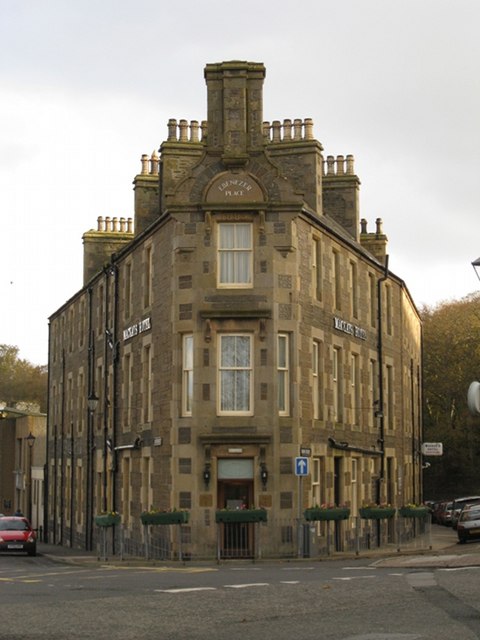
Ebenezer Place, in Wick, northern Scotland, has the distinction of being the shortest named street in the world, at 206 centimetres (81 inches).

This situation came about when Mackays Hotel was built in 1883. The building was wedge-shaped, which meant that it had one very short side. The town council decreed that, because this side also contained the main entrance which was on neither street that ran along the two long sides, the street on that short side would need to be given its own name.

 Not surprisingly, there is only one address on Ebenezer Place – Mackays Hotel at Number One!

Picture credit: ‘Noudbijvoet’. Licensed under the Creative Commons Attribution 3.0 Unported licence.
© John Welford