Showing posts with label castles. Show all posts

Wednesday, 10 October 2018

Penrhyn Castle's temporary treasures


Wales is famous for its numerous splendid castles, many of them dating from the reign of King Edward I in the 13th century. However, although Penrhyn Castle near Bangor in North Wales may look as if it is a remarkably well-preserved example of such a castle, it is far from it. It was built in 1827-40 by a man whose family fortune derived from slate quarrying, and it has been described as “a monstrously vulgar neo-Norman pile”.

During World War II Penrhyn Castle was given a particularly important role to play – not as part of the defence of the realm but as a storehouse for some of the most valuable paintings in London’s National Gallery. It was decided in 1940 that leaving them in London, then subject to aerial bombardment from Germany’s Luftwaffe, was too great a risk, and Penrhyn Castle looked to be a much safer place for some the world’s greatest artistic masterpieces to be stored.

It was not a case of the National Gallery moving to North Wales, because the paintings were not on display but simply stored in the castle, many of them stacked against the walls in the Great Dining Room.

This arrangement would have been fine had it not been that the then owner of the castle, the elderly 4th Baron Penrhyn, was not the most trustworthy guardian of treasures such as “The Rokeby Venus” by Velasquez or “The Hay Wain” by John Constable. For one thing, he had a tendency to get very drunk and stumble around the paintings, thus risking the possibility that he might thrust a boot through Van Eyck’s “The Arnolfini Marriage” or some other priceless masterpiece.

He then came up with the idea of opening a girl’s boarding school at the castle, which alarmed the trustees of the National Gallery even more as they envisaged a load of unruly schoolgirls being let loose in the Great Dining Room.

Lord Penrhyn agreed to drop the plan in return for charging annual rent for the paintings of £250. 

The question of the safety of the artworks eventually reached the ears of Winston Churchill, who urged the National Gallery to find another home for them. A place that was safe both from German bombs and a highly unstable aristocrat was found in caves at Manod, near Mount Snowdon, where they saw out the rest of the War until their return to London.

When the 4th Baron died in 1951 the castle became the property of the National Trust in lieu of death duties.


© John Welford

Thursday, 30 August 2018

Tips for visiting British castles


Tip 1 

Join English Heritage and The National Trust. Between them, and their sister organisations, they look after a large number of castles in England, Wales, Scotland and Northern Ireland, as well as many other historical buildings and places of scenic beauty. An annual membership grants free entry to most of their properties, and other benefits. You can join when you visit your first castle, or online. However, there are also castles that are privately owned and are therefore either not open at all, or are not covered by the above memberships. Some castles, such as Windsor which is a royal residence, only allow public access to part of the site.

Tip 2

Plan your castle visiting with care. There are some parts of the country that are awash with castles, and it is quite possible to visit several in a day. However, you need to allow enough time to do each castle justice, and not exhaust yourself, so, for most visitors, one before lunch and one afterwards is quite sufficient. Your planning should also take into account the fact that some castles only open for limited seasons. Also, during the summer months there are often events at castles that should not be missed, such as battle re-enactments, or displays of medieval crafts, etc, and you should plan your visits to take in as many of these events as you can.

Tip 3

Learn some background history. The main period of castle building in England and Wales was between the 11th and 16th centuries, which were turbulent, and often lawless, times, during which kings and powerful people sought to defend their territories and demonstrate their power. Knowing the reason why a castle was built, and possibly rebuilt and/or extended many times, helps towards an understanding of why a castle looks as it does today. It is also useful to understand the basic structures of castles at various times, and to distinguish between, say, a motte-and-bailey arrangement and a fortified manor house.

Tip 4

Watch the weather. Many castles in Britain are ruins, sometimes due to enemy action but more often because of the ravages of time. You can still have a great day at a castle ruin on a rainy day, but expect to get wet unless you dress appropriately! Bare stone gets slippery underfoot when wet, so wear sensible footwear and watch your step.

Tip 5

Be prepared to exert some energy! Not surprisingly for defensive structures, castles were often built on hilltops, and so a steep uphill walk is needed before the visit even begins. However, take your time and have a good look at the castle’s exterior while you pause for breath. Imagine yourself as a potential invader! When inside the walls, you are likely to find many paths to walk along, buildings and structures to visit, and stairs to climb. Be patient, especially on busy days, as you climb hundreds of steps in a spiral staircase, and be prepared to have to squeeze past other people who are coming down. Some castle buildings are enormous, and visiting every part is good exercise!

Tip 6

Keep an eye on the kids. Although the people who own and maintain ancient castles take all reasonable precautions to prevent accidents, such as covering wells and fencing off dangerous drops, they cannot guard against every eventuality, and these buildings were put there long before health and safety laws came into force! So it is up to you to make sure that everyone has a great time but does not do anything stupid. This includes making sure that they do not climb on exposed stonework (which will get worn away if everyone does this) and drop litter around the place.

Tip 7

Enjoy the experience. You can learn a lot from a castle visit, and it is certainly worth buying the guidebook. You will probably find boards placed around the castle describing each room and section, and there may be an audio guide that you can take round with you, playing the commentary into your earpiece as you reach each point of interest. Don’t overlook the castle grounds, as these are often pleasant places to walk, especially if an effort has been made to maintain them by, for example, reproducing the planting schedule of the original kitchen gardens. Also, have a look round the local town or village, as this may well have been founded at around the same time as the castle and have many stories to tell. Take your camera with you, but take note of any restrictions placed on photography.

Tip 8

Come back soon!


© John Welford

Saturday, 30 June 2018

Castles in England


There are so many castles in England that it is impossible to give anything like a complete guide in a short article. Perhaps it would be more useful, therefore, to indicate the different types of castle that can be encountered and mention a few examples of each.

A castle can be defined as a building with defence as its main purpose. The inhabitants would have a degree of safety by staying within its walls, and they could use it as a base from which to attack their enemies. A castle is therefore typified as having high thick walls, turrets and ramparts from which to observe the surrounding countryside, battlements and narrow slit windows through which to fire arrows or guns at attackers, and perhaps other defensive devices such as a moat with a drawbridge and “murder holes” (for pouring hot oil on to the heads of attackers).

The visitor can see many castles in England that fit this pattern, but there are plenty of variations on the theme, from massively impressive fortifications such as at Kenilworth, to royal palaces such as Windsor and far more modest fortified country houses such as Stokesay.

By visiting a variety of castles, the tourist can learn a huge amount about the history of England from Roman times almost to the present day. Many castles have been owned by the same families for hundreds of years and adapted as times and conditions have changed. For example, the Percy family first occupied Alnwick Castle in Northumberland in 1309, when England under Edward II was at war with Scotland under Robert the Bruce. Over the centuries, the need for a defensive stronghold has been superseded by the desire for aristocratic comfort, so the visitor can see the 18th century gothic interior designed by Robert Adam and the 19th century Italianate decoration preferred by the Victorian inhabitants. In the castle grounds is a magnificent cascade designed by the current Duchess of Northumberland.

Leaving aside the hill forts of Iron Age man, such as Maiden Castle near Dorchester in Dorset, the first castles of note in England were built by the Romans, with Portchester near Portsmouth being the best surviving example. Built in the 3rd century AD, the Roman walls still stand more than 20 feet high. The castle was much extended and altered by succeeding generations and is still in an excellent state of repair.

Any English place name with “Chester” incorporated in it (such as Colchester and Manchester) or derivates such as Gloucester, Leicester or Lancaster, denotes a Roman foundation based on a castle, although many of these are hard to find today at the heart of what can be large and important cities. For example, Leicester still has its “Castle Park” but only the outline of a castle motte. However, several nearby buildings were once part of the medieval castle, such as Castle Hall, John of Gaunt’s Cellar and the Magazine Gateway.

The Norman invasion of 1066 led to a rash of castle building as the conquering knights were assigned large swathes of English land which they had to protect as best they could. The typical pattern was the “motte and bailey” castle comprising an artificial circular mound on which the central keep would be built, and an enclosure within with there would be supporting buildings such as workshops and stables. The bailey would offer quarters for the soldiers who comprised the lord’s retinue and could also be a place of refuge for local people during times of crisis. There was sometimes an inner and outer bailey, or baileys on either side of the keep. The original buildings and ramparts would have been built of wood, but most were later rebuilt in stone, and the remains of some of these can be visited today, such as at Totnes in Devon. At other sites only the outline of the motte and bailey can be seen, or the bailey has shaped the street pattern of the surrounding town, such as the market place at Richmond in Yorkshire.

The medieval period, from around 1200 to 1600, was the greatest period of English castle building, with many of the greatest castles dating from these times. A whole series of civil wars and local conflicts led to the need for strong defence, and the result was massive fortresses such as Kenilworth in Warwickshire, Dunstanburgh in Northumberland and Carlisle in Cumbria.

The stone castles of this era were designed to withstand long sieges, maintain a private army, intimidate the locals, and provide as gracious a style of living as possible for a powerful warlord and his family. They therefore contained facilities that marked them out as communities in their own right, typical features being a great hall (often used as a courtroom as well as a place for feasting), a chapel, large kitchens, wine cellars, armouries, dungeons for prisoners and private quarters for the family. Towers provided accommodation for troops as well as good vantage points. Gatehouses with portcullises and drawbridge machinery guarded the entrance, which was often a vulnerable point in the castle’s defence.

At Dunstanburgh, for example, a castle on the rugged coast of Northumberland, a massive gatehouse guarded an enclosure that was large enough for a whole army to assemble and to provide protection for the population for miles around.

Bodiam Castle in Sussex is probably closest to the popular image of an English castle, with symmetrical round towers at each corner and a broad moat spanned by a drawbridge.

At Kenilworth, which is one of England’s most spectacular castles, Robert Dudley, Earl of Leicester, sought to impress Queen Elizabeth I by building a complete house for her within the castle walls. The remains of the house, and many more buildings, can be seen today.

Visitors to these castles should note how the inhabitants obtained their water supplies and disposed of their waste. In terms of the latter, there were often “garderobes” for the lord and his family, these being private toilets that dropped one’s “motions” straight down into the moat below!

One type of English castle that was distinctive from those described above is the defensive coastal castle that was typical of the reign of Henry VIII. A whole series of these stretched along the south coast to guard vulnerable points at which a seaborne invasion from France or Spain might be expected. These castles are typically low and circular, designed to house only a garrison of troops and provide platforms for mounting cannons. Because the threat of invasion continued for many years after Henry’s reign, most of the castles were kept in good repair and adapted to suit the needs of improved firepower as it developed over the centuries.

A good example is Dartmouth Castle in Devon, where visitors can see a series of fortifications that were used from the 15th century to the 20th, being manned as late as World War II. St Mawes and Pendennis Castles guard the two sides of the Fal estuary in Cornwall, and both castles can be visited.

During the English Civil War of 1642-9 many castles were pressed into service and re-fortified. Unfortunately, many suffered damage as a result with the victors giving orders that they be “slighted”, which meant that one wall of the keep was to blown up with gunpowder, thus causing the roof to fall in and the fortress to be unusable. This is what happened at Ashby in Leicestershire and Corfe in Dorset, to give just two examples.

As mentioned before, not all castles were intended to offer defence, and some were built with no greater purpose than for a rich person to show off his wealth. Stokesay Castle in Shropshire, although dating from the 13th century, was built at a time when there was relative peace and it was safe to put the emphasis on comfort. However, there are elements of both opulence and defence with a small stone keep adjoining the medieval manor house. The castle was never in danger and surrendered without a fight in 1645. Its virtual uselessness as a military structure saved it from the slighting mentioned above, which accounts for its excellent state of preservation today.

Castle building in England has continued into the 20th century, the best example being Castle Drogo in Devon. This was designed by Sir Edwin Lutyens to the order of a grocery magnate who discovered his Norman ancestry and wanted a castle to fit his status. The result is a country house that looks like a castle, complete with turrets and battlements, but with large windows that are more suited to viewing the spectacular scenery of the Teign Valley and Dartmoor than firing arrows at an enemy!

When visiting an English castle, the experience is often much more than simply seeing a historical edifice in a greater or lesser degree of repair. Castles often provide masses of information in terms of displays and artefacts, and sometimes double as the museum of the surrounding town or city. Splendid works of art and antique furnishings, as well as weapons and armour, are often on display, as at Warwick Castle. The castle surrounds are often maintained as beautiful gardens with the emphasis on reconstructing how they might have been in past times. Notable examples of the latter can be seen at Kenilworth and Richmond.

English castles often host events and historical reconstructions during the summer months. These are well worth planning for, as the visitor can experience a whole day of battles, military parades and demonstrations of English life and crafts from past centuries.

The visitor should bear in mind that not every building called a castle is open to the public. Some are in private hands and are lived in by the owners, who may or may not welcome visitors. Some castles are open only in part and some have very restricted opening times.

A good tip when visiting castles is to look out for those maintained by English Heritage and/or The National Trust. These organisations go out of their way to make the visit as enjoyable and informative as possible, as well as providing all the usual visitor facilities and keeping entrance fees as low as possible. An annual membership will ensure free admission to their properties and reduced charges for special exhibitions and events.

Also bear in mind that this article only scratches the surface of what can be seen in England in terms of castles. And then there is Wales, Scotland and Ireland to be visited as well!
 

© John Welford

Tuesday, 27 March 2018

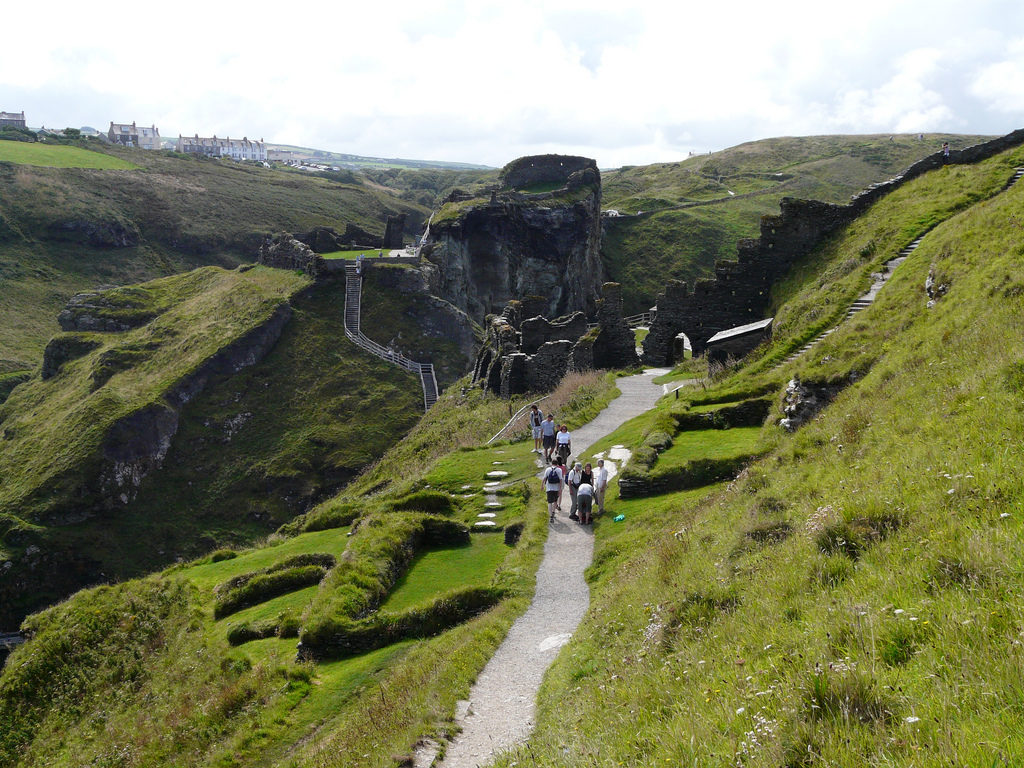
Tintagel Castle, Cornwall


This ancient castle on the north coast of Cornwall is associated with the legends of King Arthur and of Tristan and Isolde. The truth may never be known, although a 1998 find of a 1,500 year old piece of slate bearing the name “Artognou” excited a fresh round of speculation.
Although Tintagel was occupied during Roman times and was a trading post for Celts in the 5th and 6th centuries, the castle we see today was built in the 13th century by Richard, Earl of Cornwall (1209-72). Richard was a brother of Henry III, who gave Cornwall to Richard as a birthday present. What he did when Christmas came along is not recorded!
The castle is sited on a rocky island that is connected to the mainland by a footbridge. More than 100 steep steps then lead up to the castle entrance, hence it is inaccessible for disabled visitors. The castle itself is a ruin, but many features of the ground plan can be made out from the remaining walls, and the views in all directions are stunning.
© John Welford

Tuesday, 20 March 2018

King Henry VIII's Cornish castles


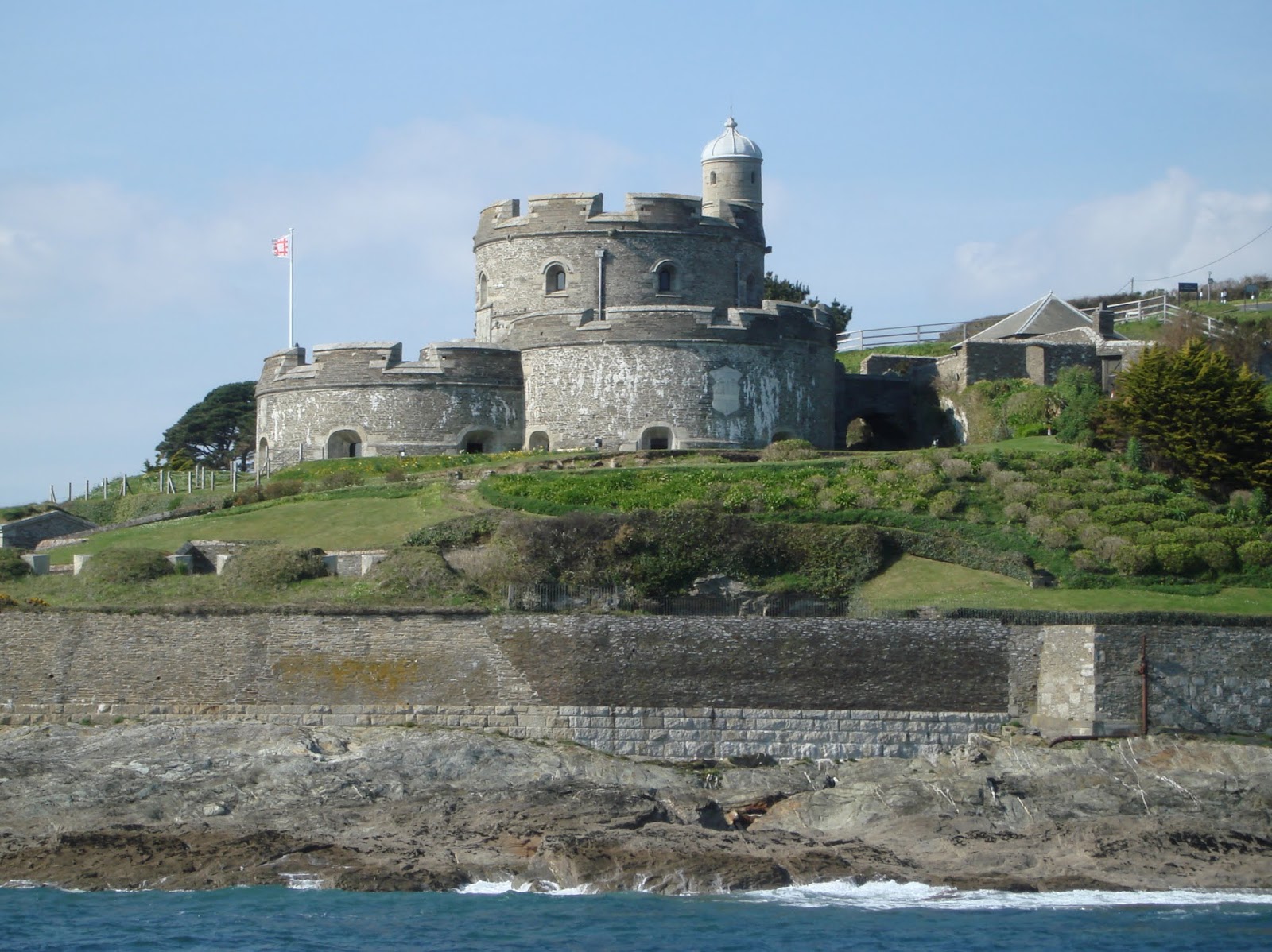
Following his divorce from Catherine of Aragon in 1533, and his break from Catholic Europe, King Henry VIII became increasingly concerned that he had made England vulnerable to invasion from either France or Spain. It was in order to guard against any threat from Spain that he built three castles in Cornwall that were designed to protect the ports of Falmouth and Fowey on the county’s south coast. These castles – armed with artillery pieces – would be the first land-based line of defence should any Spanish ships sail up the English Channel.


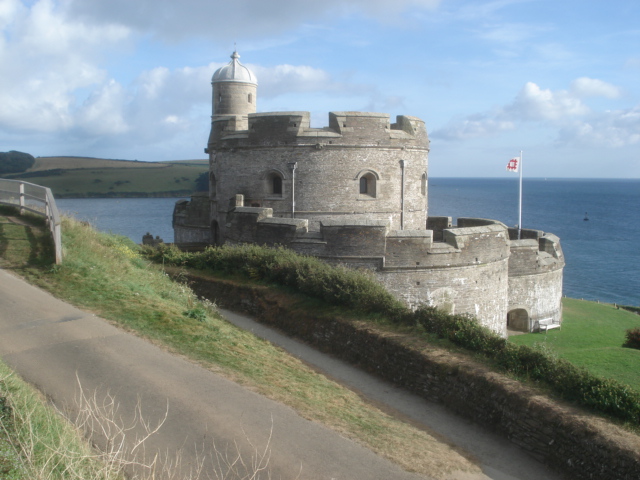
St Mawes Castle

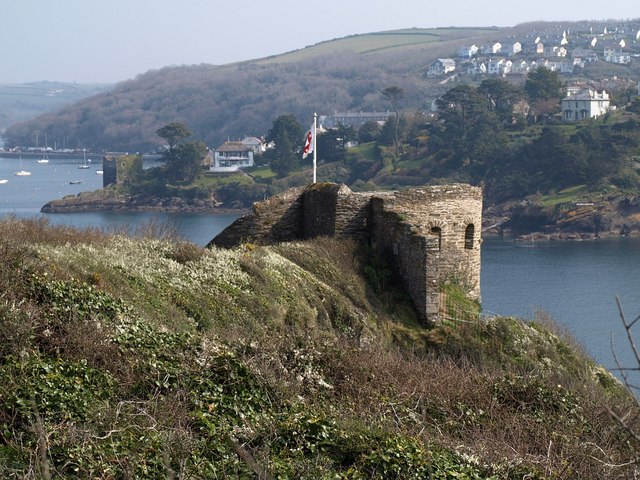
Sited on the eastern side of the mouth of the River Fal, the castle was designed purely as a base for artillery fire. There is a four-storey central round tower and three circular bastions arranged in a clover-leaf pattern. The flat-roofed bastions were simply platforms for artillery pieces.


The castle is in an excellent state of repair, this being mainly because it continued in use long after the threat of invasion during King Henry’s reign had passed. At various times it acted as a garrison, although its small size meant that not many soldiers could be accommodated. It was only at the close of World War II in 1945 that St Mawes Castle finally lost its function as a military base.
However, despite all this apparent importance to the security of the realm, no gun was ever fired in anger from St Mawes Castle!

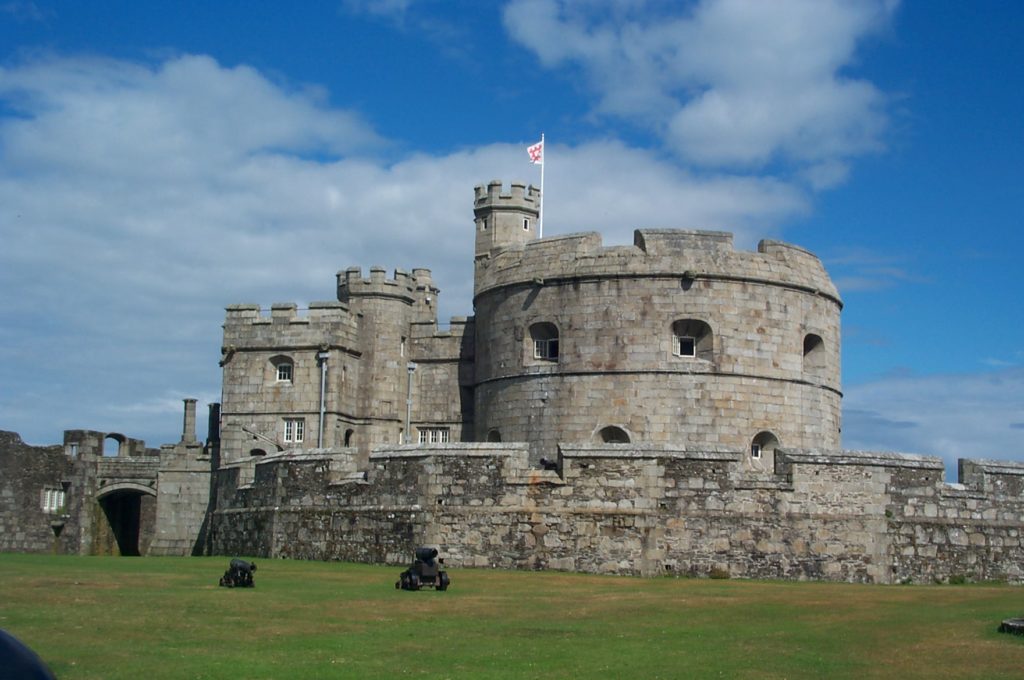
Pendennis Castle

Originally the western companion to St Mawes, and similar in design, Pendennis underwent much more development in subsequent years. Like St Mawes, Pendennis continued in use as a military base right up to World War II, but it was given greater importance because of its proximity to the port of Falmouth. New fortifications were added by Elizabeth I following the Spanish Armada, and yet more in the years preceding the English Civil War, during which the castle – held by supporters of King Charles I – was taken by Parliamentary soldiers following a five-month siege.


Visitors can see an interactive exhibition of the castle’s history, mounted in the Royal Artillery Barracks that date from 1901, and a special collection of World War II cartoons by the artist George Butterworth. A land train connects the castle with Falmouth town centre during the summer months.


St Catherine's Castle

This is another of Henry VIII’s coastal defensive castles, built to defend Fowey, some 20 miles north-east of St Mawes/Pendennis. This castle is nothing like as well preserved, consisting of a round two-storey tower, now open to the elements, with gun ports at the ground level. A small gun platform was added in 1855. The castle can be reached via a woodland path or from the beach of nearby Readymoney Cove. As this site is unstaffed, admission is free.


It should be noted that times of admission to these three castles vary considerably from site to site and they also change depending on the day of the week and the month of the year. Intending visitors should check the English Heritage website to avoid a wasted journey.

© John Welford


Monday, 28 November 2016

Durham Castle


If you are visiting Durham you should definitely include Durham Castle on your itinerary. However, there are a few things about such a visit that are a little out of the ordinary.

Durham Castle was originally built by the Normans in the 1070s and, like most castles in Great Britain, there has been a considerable amount of alteration and fresh building work done in the intervening centuries. The purpose of building a castle here was that King William I (the Conqueror) needed a strong base from which to complete his conquest of northern England, which had proved to be very difficult.

He delegated the task of securing the northern counties to the bishops of Durham, who were known as “Prince Bishops” from 1076 to 1837. During this time, therefore, the Castle was the official residence of the Bishop of Durham.

However, in 1832 the University of Durham was created, and from 1837 the Castle became the central focus of the University. The Bishop moved out (to Bishop Auckland) and the Castle became University College Durham, which is still its status today.

This means that the visitor is seeing not only a castle but also a working college of a university. If the visit is made during term-time there are quite likely to be students and staff moving about, which in turn means that visitors have to be escorted around the castle and there are many areas that are “out of bounds”.

Three tours are held each day – at 2.00pm, 3.00pm and 4.00pm – and tickets can be bought in advance (£5.00 each) at the old university library on Palace Green just outside the Castle.

The tours are conducted by college students who are not only highly knowledgeable but also very personable and willing to answer questions about student life as well as the history of the Castle. The guide will make clear at the outset that photography is allowed outside the buildings but not inside.

The tour does not include the Castle keep, which consists almost entirely of student rooms. Instead, the group of visitors is taken first to the Great Hall, which is used these days for formal college meals. At one end is a gallery in which are displayed weapons and armour that date from the Civil War – the armour was used for test purposes to see how well it kept musket balls out!

The Tunstall Chapel is next on the itinerary, with its fascinating carved misericords (upturned seats so that a worshipper could stand and rest at the same time). The passageway leading to the chapel contains a very rare feature, namely a Norman archway that is probably the best of its kind anywhere. It was the original entrance to the Castle, and was therefore ornately carved, but it was preserved from wear and tear by being covered in plaster for centuries and also because an outer wall has now been built to create the passageway which thus keeps protects the archway from wind and weather.

The “black staircase” dates from the 17th century. It was originally designed to be free-standing, but it soon became clear that it would need pillars to support it. Unfortunately even these are now showing signs of serious strain which means that only the lowest section of the staircase can be used. An interesting feature of the staircase is the pineapple design of its finials, made at a time when pineapples were extremely rare in England – to display a pineapple, even a wooden one, was a sign of one’s wealth. Unfortunately, the carver of these pineapples had clearly never seen a real one!

Perhaps the most remarkable survival from the past is the Castle’s original Norman chapel that has remained virtually unaltered for more than 900 years. The walls are five feet thick apart from one place where the wall could, if necessary, be breached from the inside to provide an escape route from the Castle. Six round pillars support the roof, and the capitals of the columns are decorated with carved reliefs that are only partially inspired by Christian iconography. There is, for example, a pagan “green man” and the earliest known representation in the country of a mermaid.

The Castle tour is well worth the fiver, and you might consider the student’s suggestion of an extra contribution towards their tuition fees (or beer fund) not to be at all unreasonable!

© John Welford

Wednesday, 27 April 2016

Ashby-de-la-Zouch Castle, Leicestershire


Ashby-de-la-Zouch is a small market town in the far west of Leicestershire, within easy reach of all the major cities of the region via the motorway network. Its chief feature is undoubtedly its partially-ruined castle, which is well worth a visit.

The castle must be approached on foot, although there are car parks in the town not far away. The feature that strikes the visitor first and foremost is the massive tower on the right-hand side of the range of buildings. This is the 80-foot high Hastings Tower, but you may want to leave its exploration until last.

Ashby Castle dates from the mid-12th century, when the manor of Ashby was held by the Zouch family, but the remains you can see cover a range of dates up to 1483, when the Tower was completed by William, Lord Hastings, who lost his head on the orders of King Richard III in that same year.

One way to explore the castle is to work your round from left to right, starting at the kitchen and ending at the tower, or there is another, very unusual, way, which will be mentioned soon! The buildings you can see are in various stages of ruin, with nearly all the rooms open to the sky and some of the walls reduced to outlines on the ground, although others reach two or more storeys high.

Much of this ruination was deliberate, as the castle was one of many that were “slighted” during the English Civil War, with the destruction at Ashby taking place in 1648. The slighting of a castle meant the blowing up with gunpowder of one complete side of each building, thus causing roofs to collapse. Local builders would have helped themselves to free building stone over the coming years, thus leaving the site in a condition close to what can be seen today.

The kitchen complex is of considerable size, and, with a little imagination, one can picture the hive of activity that this would have been during the heyday of the castle when the Lord of the Manor was feasting in the great hall. You can see two massive fireplaces, a cauldron recess and an oven in the remaining walls, and there may have been more in the west wall, now missing.

Any children in your party will probably be far more interested in the “secret” passage that leads underground from the kitchen to the Hastings Tower, which is the alternative means of exploration mentioned above. When I first visited Ashby Castle, some years ago, this passage was unlit, which meant a slightly scary experience as you felt your way along in pitch darkness. However, health and safety rules have now meant that you are less likely to bump into somebody coming the other way, although the passage is still narrow, not straight, quite low, dim and damp, especially after heavy rain.

Continuing round the buildings from the kitchen you come to the buttery and pantry, which were originally the solar, and then the great hall, which would have been the heart of the castle, used not only for meals but holding court and as the dormitory for most of the castle’s inhabitants. You can make out where the hearth would have been, this being an open fire near the centre of the hall, the smoke of which would have escaped via windows or a hole in the roof.

Next is the solar, being the private quarters of the lord’s family, which would have been on two floors with divisions into separate rooms. Then visit the chapel, much of which was built at the same time as the tower and would have been a very impressive building, both in size and quality. The adjoining “priest’s rooms” are unlikely to have been used for this purpose.

The Hastings Tower, when complete, was virtually a castle within a castle, as it rose to 90 feet when first built, part of it comprising four storeys and part of it seven, thus allowing for plenty of accommodation. The tower would have had its own kitchen, water supply and latrines, and therefore have been self-contained as a fortified manor house during a time of conflict. Given that its builder, Lord Hastings, was an active participant in the Wars of the Roses, it is hardly surprising that he had this aim in mind.

Although the bulk of the tower has been lost, one important feature still remains, this being the spiral staircase that leads all the way to the top, and which is perfectly safe to climb. As you pass each doorway on the way up or down, there is somewhere to stand aside so that you can pass people going the other way. Take care when climbing the stairs, especially on a wet day, because many of the stones are worn and uneven, although some have been replaced by modern steps, especially near the top.

The climb is well worth the view you get from the top, where there is room to stop and look around without getting in anyone else’s way. You can see right over the town of Ashby and across into the Leicestershire countryside. Keep an eye on the children, though, because it is possible that someone could fall over the edge, and it is an 80-foot drop to the grass below.

There is a large grassy area adjacent to the castle, this being the site of the original garden and fish ponds. This is great for allowing children to run around in, especially as there are safe grass slopes to roll down! On certain days of the year this area is used for historical displays and reconstructions.

West Leicestershire is not normally on the tourist trail, but Ashby is not far from the popular destination of Burton-on-Trent, famous for its brewing connections, and is close to the A42 main route from Birmingham to Nottingham. Ashby is itself an interesting town to wander round, and an hour’s break to visit the town and its castle would be well repaid.


© John Welford

Saturday, 9 April 2016

Dartmouth Castle, Devon


The south-west peninsula of England is well-known for its flooded river estuaries that provide sheltered moorings for shipping of a reasonable size; at least, what would have been considered reasonable in past centuries. These estuaries needed protection from incursions by foreign warships, and there are several castles that perform this function. The River Dart, in Devon, was guarded by two castles near its mouth, Kingswear on the eastern shore and Dartmouth on the west.

A succession of “castles”

What the visitor to Dartmouth Castle will see is a variety of methods used to defend the estuary, dating from the 14th century to the 20th. The first fortification was a “fortalice” or small fortress, the remains of which are visible next to the car park. We know that, from the 15th century, chains were stretched across the river to prevent ships from getting upstream.

However, it was not until 1481 that the present castle was started. Unusually, it seems to have been built on the initiative of the townspeople and not of a monarch or nobleman. This was probably due to a succession of scares occasioned by French raids on the Devon coast, which were partly in retaliation for attacks by English ships. There is, however, plenty of evidence of royal support by successive monarchs for the castle-building effort.

The castle, which is not particularly large, took a long time to build, and it was 1493 before work began on the roof. There was also a major change of plan in that the original round tower was supplemented by a rectangular tower and the two structures merged into one. This gives the castle a most unusual shape.

In the 16th century, a gun battery was built a short distance from the castle, on the seaward side. This was altered in 1690 and again in 1747, but then a new battery was built on the site in 1861, this being known today, somewhat confusingly, as the Old Battery. The site was last fortified in 1940.

A site for artillery

When visiting the Castle and the Old Battery, it is important to bear in mind that the whole site was designed to be used by artillery. When the 15th century castle was being built, it was the first such in England, although the coastal forts built by Henry VIII in the next century took the idea forward and introduced many important refinements.

The visitor’s tour starts at the Old Battery, where you can see the two-tier battery and look out at the area of sea that it would have defended. On the upper tier is one of the original cast iron 64-pounder guns (issued to Dartmouth in the 1890s, but actually somewhat older than that), mounted on a modern replica carriage.

On the lower tier are three “casemates” or fortified compartments, “armed” with another 64-pounder gun from the 1890s and two 24-pounders from the late 18th century. You can also see much of the equipment that would have been used for firing the guns, as well as the magazines used for storing shells and cartridges, these having wooden floors to avoid the danger of sparks. Note how the guns could be swung round to provide fire across a wide arc.

When you walk along the short cliff path to the Old Castle (also passing St Petrox Church which is right next to the castle) you move back through the centuries. You can see where the building of the round tower stopped, and then re-started with different materials after the square tower had reached the same height.

The Old Castle

The castle is on three floors, and you enter at the ground floor level. Here you can see openings in the walls for the use of various sizes of gun, and the large opening in the round tower that was probably the porthole for the chain that was slung across the river to Kingswear Castle on the other side.

In the basement you can see further sites for gun emplacements. Alterations were made in the 16th century to lower the floor and raise the ceiling, but before then this must have been a very cramped area in which to work, and extremely noisy and uncomfortable when the guns were fired.

The first floor was the main living area, now open but formerly divided into two barrack rooms and what was probably the quarters of the castle governor.

From the ground floor you can walk out on to the adjoining open-air gun platforms, to the north and the south. The northern platform would have offered firepower over the river upstream of the castle, should any enemy ship have been able to get that far. These platforms are currently “armed” with cast-iron cannons from the 17th, 18th and 19th centuries.

The town of Dartmouth

While visiting Dartmouth Castle, you might also like to explore the delightful riverside town of Dartmouth, which is home to the Royal Naval College. A walk along the wooded banks of the river, or a boat trip along or across the Dart, is a very pleasant way to pass the time.

It was at Dartmouth that the Pilgrim Fathers put in for repairs on their way from Southampton to the New World in 1620.

Dartmouth Castle is under the care of English Heritage, and may be visited free of charge by English Heritage members. The castle is open every day of the week from April to October, but only at weekends from November to March.


© John Welford